Operational Financial Intelligence · Platform Overview

The Cost-to-Serve Engine for 3PL & Warehousing.

Not a calculator. Not a spreadsheet. The real cost behind every rate.

CostAware is an Australian-built Commercial Intelligence platform that turns warehouse operations into defensible pricing — every charge traced back to the work behind it. Understand your costs. Build better pricing. Protect your margin.

Experience CostAware →   Talk to Us
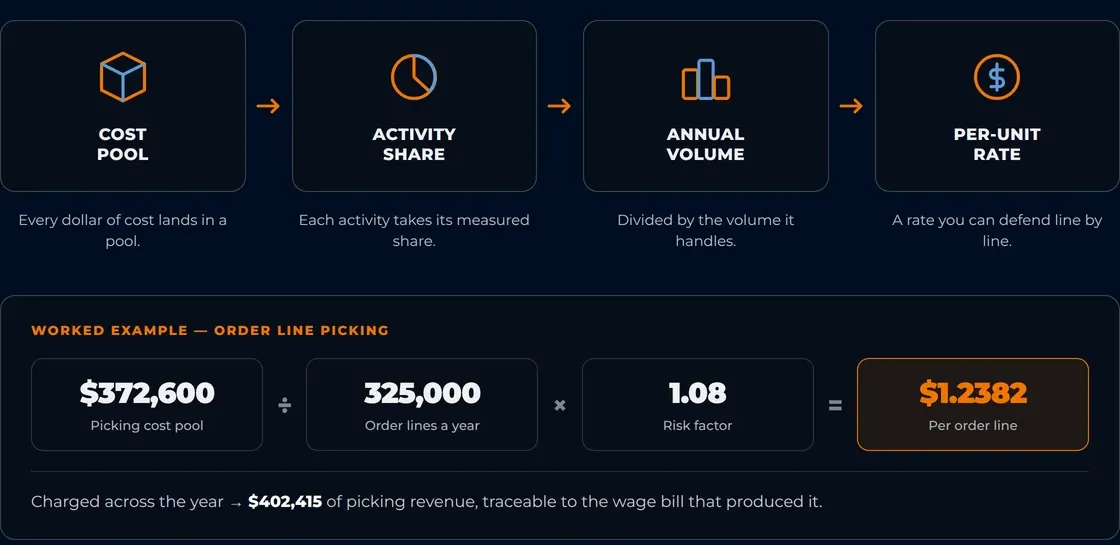
How a CostAware per-unit rate is derived: cost pool, activity share, annual volume and risk factor producing a defensible $1.2382 per order line rate
UNDERSTAND · CONNECT · DECIDE · GROW
100%Auditable calculations
3Commercial pricing models
0Broken formula links
Multi-site contracts
The Starting Point

Three Commercial Questions Every Operator Must Answer.

CostAware connects operational, financial and commercial intelligence in one platform — a single source of truth for every stakeholder.

🧮

Cost to Serve

What does it really cost to serve this customer? Every cost required to fulfil the commitment — labour, space, equipment, systems, and the slice of overhead this customer consumes.

🏷️

Pricing

What should we charge? Build pricing from your own operational data with a transparent, consistent methodology — not from a competitor's card or a gut feel.

📈

Profitability

Are we actually making money? Margin visibility by customer, site and contract — while there is still time to act on it.

One connected view. Better commercial decisions. Miss one cost and the contract is underpriced before it starts.
The Problem

There Is No Such Thing as a Standard Warehouse Rate.

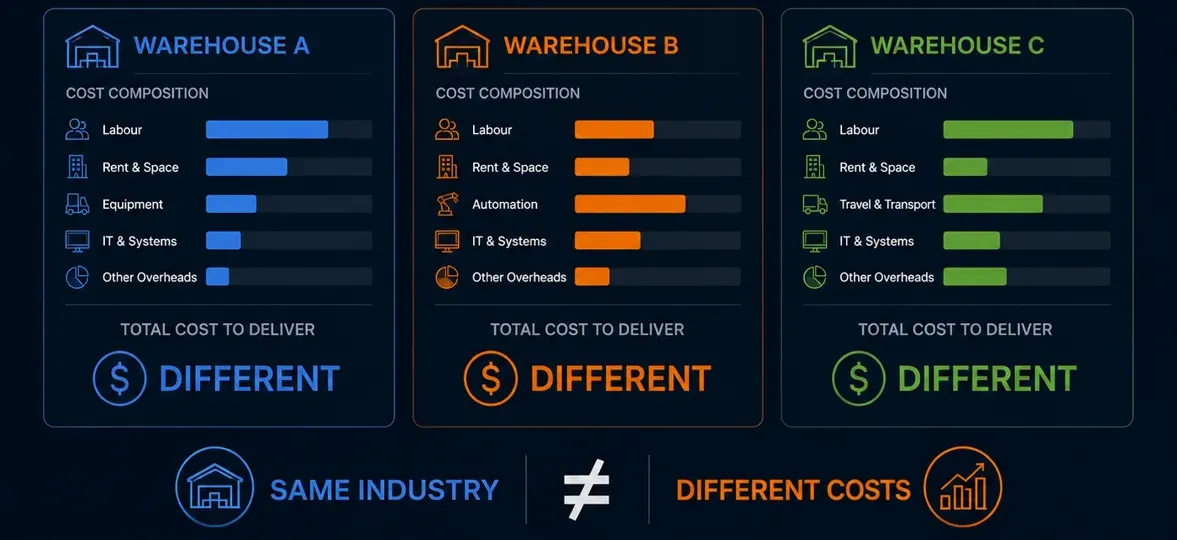
A warehouse rate isn't a benchmark. It is the result of your operation — your labour, your space, your systems, your equipment.

Same service, different cost to serve — and therefore a different rate.

A single blended charge is too high for some customers and too low for others.

Margins erode quietly, and the wrong business gets won.

Stop comparing rates. Start understanding the costs underneath them.
Three warehouses in the same industry compared side by side — different labour, space, equipment and overhead mix, so a different total cost to deliver
Where It Goes Wrong

The Old Way vs the CostAware Way.

Data doesn’t automatically create understanding. The value isn’t in having more of it — it’s in understanding it well enough to make a better commercial decision.

DATAWhat happened — volumes, labour, rates, costs, spread across systems
UNDERSTANDINGWhy it happened — the relationships and reasons behind the numbers
COMMERCIAL THINKINGWhat you should do about it — impact, trade-offs, priorities
BETTER DECISIONSMade on what is actually happening — not on assumptions
THE OLD WAY
THE COSTAWARE WAY
Multiple file versions emailed back and forth
One platform — a single source of truth
Hidden formula errors pricing real contracts
Validated, auditable calculations
Weeks to build a tender
Minutes to generate
No audit trail — silent changes
Full change tracking on every number
Knowledge locked in people's heads
Knowledge held in the system
Copy-paste to set up every new site
Template-driven creation, configurable without code
Stop managing data. Start understanding it. Better decisions. Lower risk. Greater control.
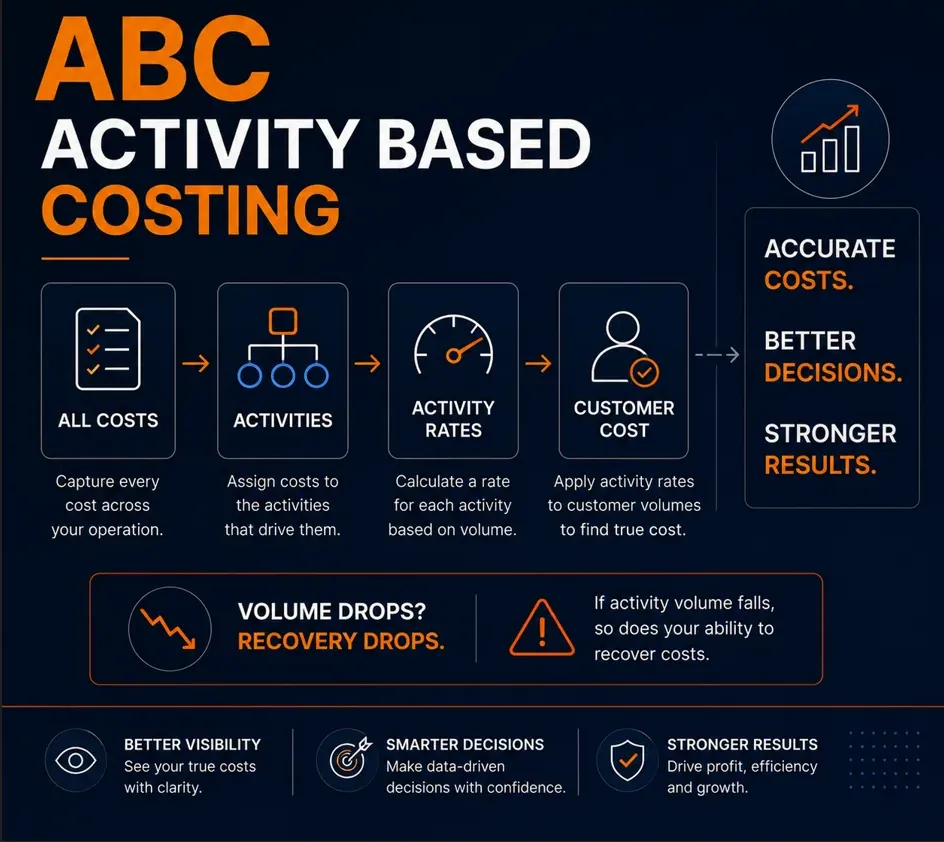
Activity-based costing flow: capture every cost, assign costs to activities, calculate a rate per activity from volume, apply activity rates to customer volumes to find true cost
The Method

Why Activity-Based Costing Changes Everything.

Not all work is the same, so why treat it like it is? Activity-based costing connects your costs to the work that drives them.

Traditional costing spreads costs evenly and distorts true profitability.

Activity-based costing assigns costs to the actual work and reveals it.

See the true cost to serve — identify unprofitable customers and products, improve pricing accuracy, drive better commercial outcomes.

How CostAware Works

From New Quote to Approved Price, in Five Steps.

This is the whole workflow. No formulas to build, no linking, no copy-paste — the engine does the arithmetic while you describe the operation.

1

Create the Quote

Create or choose a costing model — start from a sector template or your own.

2

Add the Site

Single or multi-site — each site carries its own rent, labour agreement and running costs.

3

Enter Volumes

Apply the customer's operational volumes — orders, lines, cartons, pallets, containers.

4

Costs Applied

Labour, space, equipment, overheads and every other cost — calculated automatically.

5

Review & Submit

See pricing, revenue, margin and profitability — then submit for approval.

Under every step runs one deterministic pipe — volumes → activities → people → costs → pools → rates & budgets — worked out once, in order, every time.

Change one input and everything downstream re-flows from that point. You're not pressing recalculate — you're watching the pipe re-flow.
Labour, Wages & Shifts

People Numbers Don't Come From Guesswork.

VOLUME ÷ PRODUCTIVITY ÷ UTILISATION = FTE. Add up every live activity and you have the site's total labour need, built from the actual work — defensible when a customer challenges the headcount.

Wages don't tell the whole story

Every pay rate is grossed up to the true cost of employment — super, payroll tax, workers' comp, leave loading and long service, using the statutory rates for the site's state.

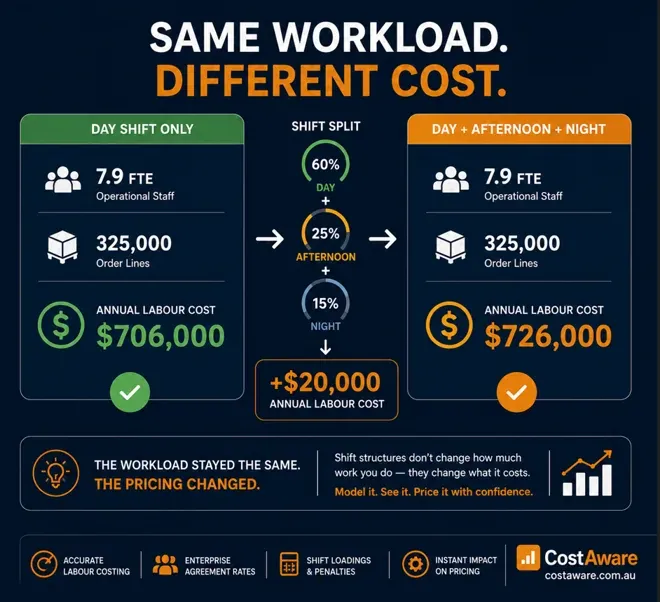
Same workload, different cost

The labour requirement is split across day, afternoon and night shifts. Penalties and overtime are costed as their own resource, not averaged away.

Permanent, casual and agency costed differently

An agency charge rate already contains super, leave and margin — so it is never grossed up twice.

The same 7.9 FTE and 325,000 order lines costing $706,000 on a day shift versus $726,000 across day, afternoon and night — the workload stayed the same, the pricing changed
The Cost Pools

Every Cost Lands in a Pool.

As each cost is worked out it is sorted into a pool by its nature — including the building, equipment, licences and capital, each recovered on its own proper basis. Pooling is what lets the rate card be rebuilt in any shape without ever losing a cost.

1

Activity

The variable labour of doing the work — wages and the variable slice of supervision.

2

Storage

Rent, site running costs and storage insurance — the cost of holding stock.

3

Fixed & Overhead

The fixed management fee, overhead services and general fixed costs.

4

IT

WMS and transport licences, IT equipment and telephony.

5

Pallet Hire

The managed pallet-pool cost — hire, issue, delivery, admin and loss.

On top sits the commercial layer — corporate overhead and profit, applied as a mark-up or as a margin, in any combination you use.
Commercial Pricing Models

Before You Build a Rate, Decide How You Recover Cost.

Three ways to package a deal — and the choice decides who carries the risk when volumes land differently from forecast. CostAware makes it a switch, not a rebuild.

Volume-Sensitive

Full ABC

  • One rate card, no separate fixed fee
  • Fixed overhead spread across every unit rate
  • Recovery rises and falls with actual volume
  • Best when volumes are well understood and stable
Balanced

Fixed + ABC

  • A fixed fee alongside activity rates
  • Fixed fee covers operational overhead
  • Overhead protected even if volume disappoints
  • Stability where you need it, flexibility where it matters
Lowest Risk

Cost Plus

  • Fixed plus variable, billed open-book
  • Billed at actual cost plus an agreed margin
  • Lowest risk to the 3PL, least predictable for the customer
  • Best when neither side can commit to a firm rate yet
The same money, packaged differently — at forecast volume all three recover the same total cost.
Built For Real Quotes

Choose. Configure. Trust.

Activities switch on and off per quote — each one shows its cost impact, and every change is recorded. Nothing more than the deal needs. Nothing less. Nothing untracked.

ActivityIn This QuoteCost Impact (p.a.)
Inbound ReceivingUnload, check, put-away$96,300
PickingPick customer orders$213,750
PackingPack orders to standard$71,200
Value-Add ServicesLabelling, kitting$23,400
Cycle CountingInventory accuracy$11,850

Change History

Value-Add Services DEACTIVATEDM. Harrington · Reason: not in scope for this quote
Packing ACTIVATEDD. Okafor · Reason: added per customer requirement
Draft createdD. Okafor · Totals update automatically with every change
Every change is recorded — who, what and why. Use the cost model that reflects your operation and protects your margin. Full visibility. Full control.
The Rate Card

Single or Mixed, With No Recovery Risk.

Every activity is pointed at a rate-card line. Point them all at one line and you get a blended charge; point each at its own and you get a granular card. Seven rate types cover the lot:

Activity

Per order, line, unit, carton, pallet or container.

Storage

Per pallet per period — standard and premium space.

Fixed Weekly

The flat management fee and IT systems fee.

Pallet Management

Recovery of the managed pallet-hire cost.

Cost Plus

Pass-through items billed at cost plus a markup.

Ad-hoc Labour

An hourly rate, billed only when those hours occur.

Manual

A line the estimator prices by hand for anything bespoke.

100% Recovery

However you slice it, every activity's labour lands on a billable line and the shares add up to the whole.

A minimum-recovery floor checks the priced card against the weekly cost of permanent staff and core equipment. Mixed versus single is a presentation choice — never a question of whether you get your money back.
The Contract Lifecycle

Quote. Live. Actuals. Renewal.

A CostAware contract moves through four stages, and the platform behaves differently at each.

1

Draft

Fully editable. Every change re-flows the whole pipe instantly — volumes, activities, rates, margin. This is where the deal is shaped.

2

Live

Once agreed, the budget is frozen as the signed commercial baseline. Amendments are formal variations, not silent edits.

3

Actuals

Real monthly volumes and costs are logged against the plan, so margin drift shows up while there is still time to act.

4

Renewal

A new version re-based on the last twelve months of real actuals rather than the original forecast — one click to clone and reprice.

The model closes the loop: the operation's own history becomes the input to its next price. It gets more accurate the longer the relationship runs. Margin drift found in month three is a conversation; found at renewal it is a loss.
Multi-Site Contracts

One Warehouse. One Source of Truth.

Set up your customers, sites and industry defaults once. Quote with confidence every time, across every site in the contract.

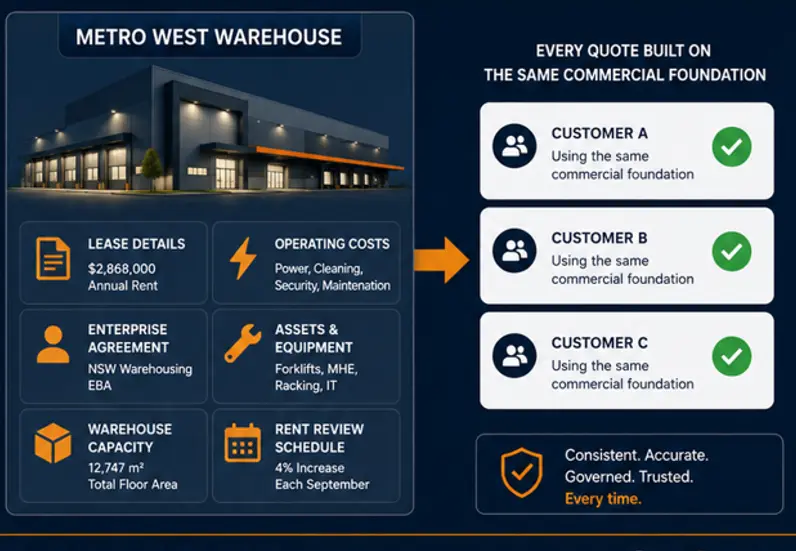
A site is a master record — floor area, rent, running costs, labour agreement and rent review schedule. It exists once, however many customers you quote into it.

Each quote takes its own copy of that site, so you can shape it for this customer without disturbing the master or anyone else's numbers.

Multi-site contracts consolidate automatically, with full per-site detail underneath the rollup.

Consistent. Accurate. Governed. Trusted. Every time.
One warehouse set up once as a master record — lease, operating costs, enterprise agreement, capacity — with every customer quote built on the same commercial foundation
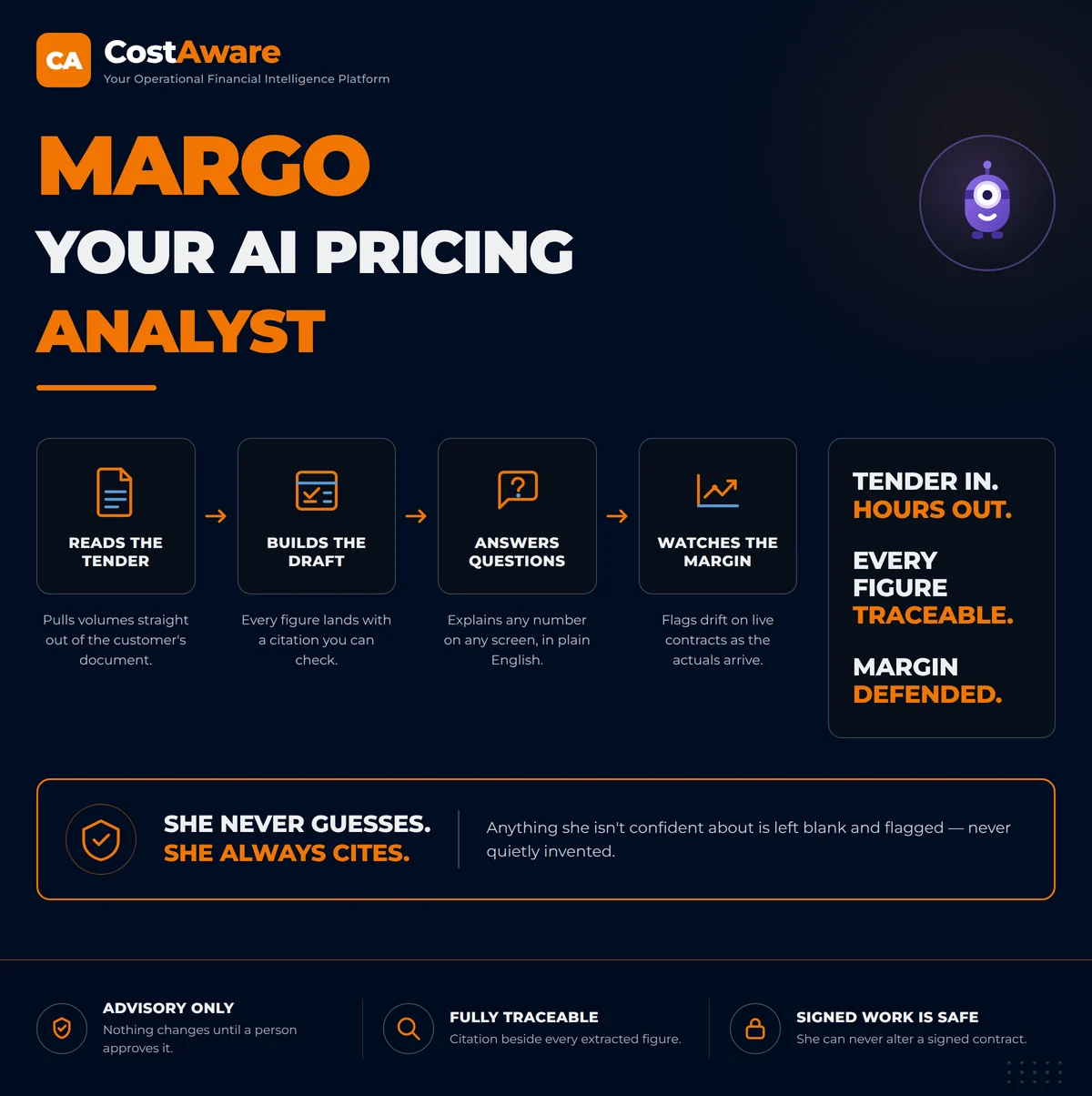
Margo, the CostAware AI pricing analyst — reads tenders into costed drafts, answers questions on your numbers, watches margin drift and calibrates productivity rates
Margo — AI Built Into the Engine

An Analyst Who Reads Your Tender and Your Numbers.

Margo works on the same live model as everyone else. Every figure she produces traces back to a calculation you can open and check.

Tender to draft quote

Upload the RFP — volumes pulled from the document and priced on your data, with a confidence band beside every figure.

Answers on your numbers

Ask why the pick rate moved and she reads the live quote, citing the page each fact came from.

Watches for margin drift

When labour cost or billed volume drifts from plan, she raises it as a task with month-by-month evidence.

Calibrates productivity

Measures what your sites actually achieve and suggests a corrected rate — for a human to approve.

Advisory only. Margo never touches a signed contract, and nothing changes until a person approves it. Meet Margo →
Financial Value

Where Does CostAware Create Financial Value?

CostAware helps reduce manual effort, identify hidden costs and improve the commercial decisions that directly influence margin.

Reduce

  • Manual costing time
  • Spreadsheet dependency
  • Pricing errors
  • Rework and re-pricing
  • Tender preparation time

Identify

  • Unprofitable customers
  • Under-recovered costs
  • Margin leakage
  • Productivity gaps
  • Cost anomalies

Improve

  • Pricing accuracy
  • Cost recovery
  • Customer profitability
  • Margin visibility
  • Commercial decisions
CostAware turns insight into impact. Better visibility. Stronger margins. Stronger business.
Experience CostAware

See What CostAware Could Look Like for Your Business.

A working warehouse, priced and trading, in about ten seconds. No password, no sales call — or book a demo and we'll walk your own numbers through the engine with you.

Experience CostAware →    Talk to Us

Locked launch pricing

Foundation partners lock their launch price for 12 months.

Shape the roadmap

Direct input into what gets built next, with named co-development.

Results, published honestly

Case studies and customer numbers will appear here — only figures we can substantiate.

UNDERSTAND · CONNECT · DECIDE · GROW

Warehouse Costing Knowledge Base

Guides and deep dives on 3PL costing, pricing, tenders and contract management — view all 16 articles →