Margo reads your customer's tender and turns it into a costed draft. She answers questions about your own numbers on any screen. She watches your live contracts for margin quietly leaking away. And she learns what your warehouses actually achieve, so the next quote is priced on evidence instead of a guess.
She never signs anything. She never changes a live contract. And when she doesn't know, she says so.
Most "AI in software" is a chat box bolted onto a product. Margo is different, because CostAware already holds the thing that makes an answer worth having: a complete, connected cost model of every warehouse, contract and quote you run.
Margo works on that model. Every number she quotes is one your platform actually calculated — not a plausible-sounding figure she invented. She can point at the screen it came from.
And she is deliberately built as an adviser, not an operator. She proposes; a person decides. That single design choice is what makes it safe to let her near a commercial decision.
Not a roadmap. These are working features inside the platform.
Drop in the customer's RFP — PDF, Word, Excel or CSV — and Margo pulls out the operating numbers that drive your cost model: pallets in and out, orders and lines by channel, cartons packed, containers received, storage on hand, SKU counts, cycle counts. She fills a draft quote with them.
She also notices the things around the edges: who the customer is, the site size, the start date, the contract term, whether dangerous goods or temperature control are mentioned, and the tender's own reference number. Start a brand-new quote from a document and those details fill the form for you.
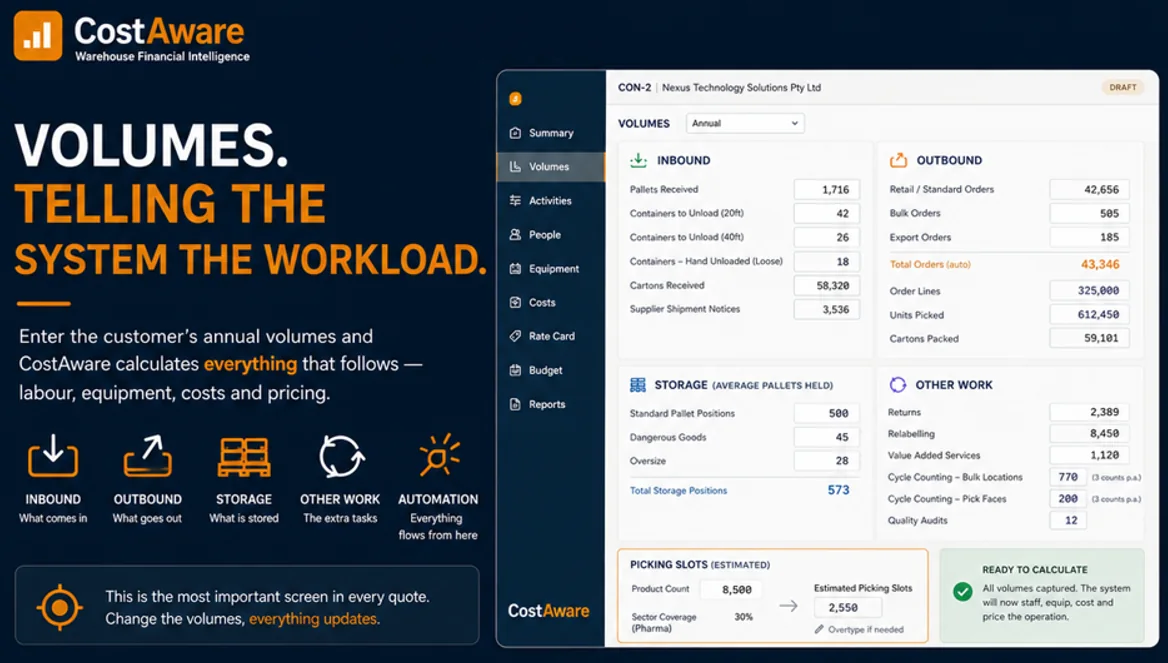
Stated plainly in the document. Pre-ticked, ready to apply — with the sentence it came from shown beside it.
Implied, converted or assembled from more than one line. Left unticked on purpose, so a human makes the call.
Dropped entirely. A blank you can see beats a guess you can't. Nothing is invented to fill a gap.
You review, tick, and apply. Applying is an ordinary edit — it lands in the change log, triggers a full recalculation, and obeys every permission and lock the platform already enforces.
Margo sits in a drawer on every screen. Ask "why is this quote's margin lower than the last one?", "which contracts are running over budget?", "what's driving the labour cost on this site?" — and she goes and reads the actual pages to answer.
She can open your rate card, annual budget, wages and labour build, ABC allocation, fixed costs, storage, volumes, financial returns, start-up costs and budget-versus-actual — plus a portfolio view that sweeps every contract at once. Her answer names the screen each figure came from, so you can go and check her.
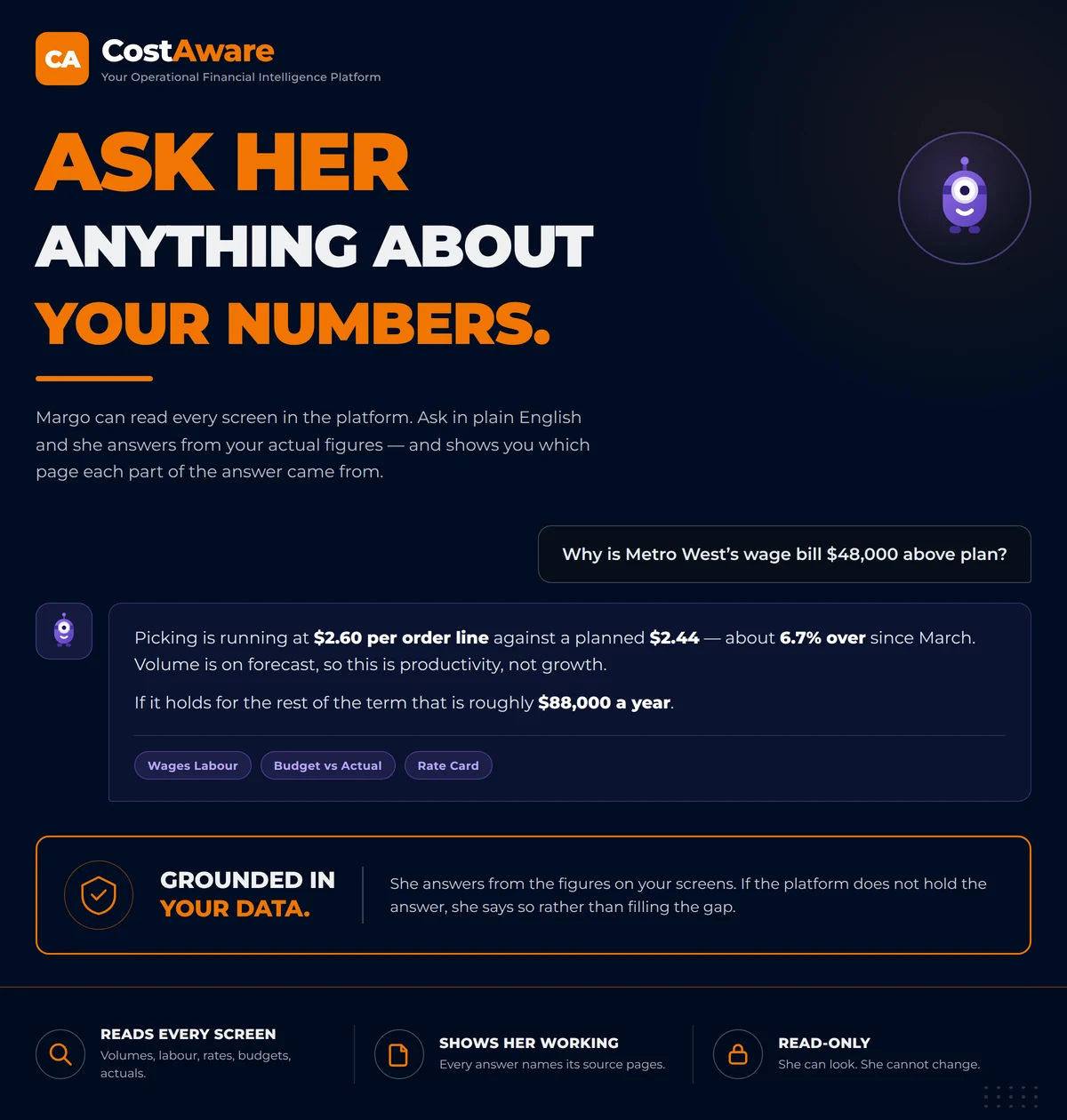
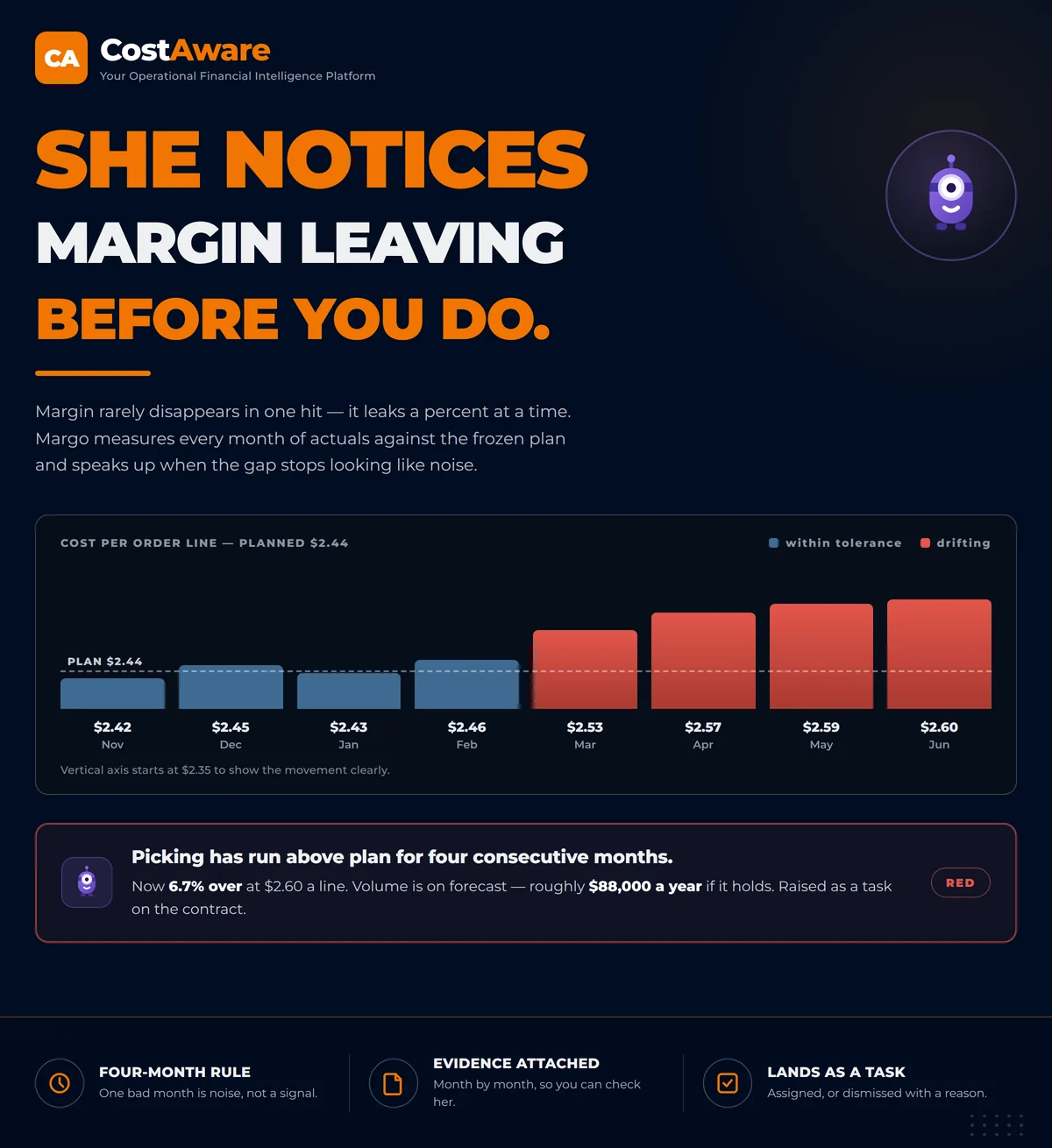
Margin rarely disappears in one dramatic hit. It goes a percent at a time — a shift that never quite came back down, a volume mix that shifted, a pick rate that slipped after a system change. By the time it shows up in a year-end review it has been happening for eight months.
Once a live contract is receiving actuals, Margo compares what's really happening against the plan that was signed, month by month, and speaks up when the gap is both persistent and material. Not noise. Not a red light every month.
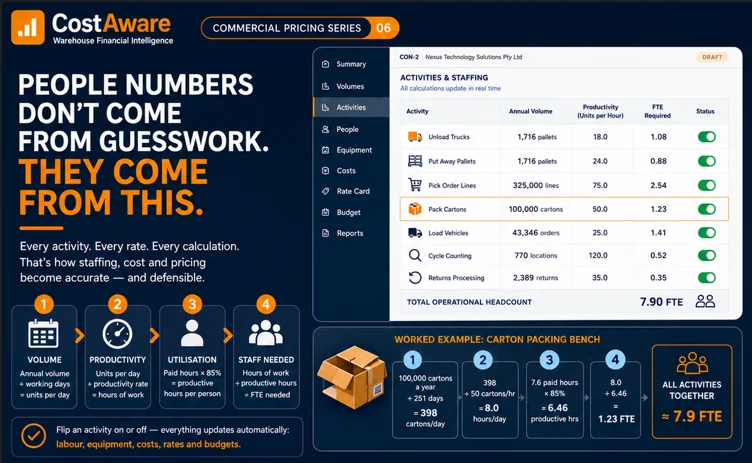
Every cost model starts on industry productivity assumptions — cartons per hour, pallets put away per hour, lines picked per hour. They get you moving. They are almost never exactly what your site achieves.
Margo measures the difference from your own actuals and proposes a corrected rate for that specific warehouse. She only speaks when there's enough history to mean something and the gap is big enough to matter — and you tick which corrections to accept.
The rules below aren't a policy page. They're how the software is constructed.
Margo proposes; a person approves. She cannot create a quote, change a rate or send a document on her own. Every suggestion has a human between it and the customer.
A contract that has been accepted is frozen at the platform level — not by asking the AI nicely. Margo can read a live contract and comment on it. She cannot alter it.
Where the evidence isn't there, Margo returns nothing and says why. Silence is a feature. A confidently wrong number in a tender is the expensive failure mode.
Extracted figures quote the line of the document they came from. Answers name the screen they were read off. You can always check her working.
Tenders you upload are used to build your quote and are filed against it — not used to train a model. Your commercial position is not somebody else's training data.
Anonymous, aggregated industry benchmarks are opt-out, never show another operator's figures, and are only ever released once enough contributors exist that nothing can be traced back.
Every Margo feature is measured against a marked exam paper before it ships — real documents with known correct answers. The bar isn't "sounds impressive". It's gets the critical figures right and never confidently wrong. Any change to how she thinks — a new model, a reworded instruction — re-sits the exam before it reaches you.
No separate AI console to remember, no copy-pasting numbers between tools.
Upload the tender in the new-quote window and the customer, dates and volumes are waiting for you.
Import from a document at any time and review each figure before it lands.
The ask drawer travels with you — rate card, budget, wages, actuals, portfolio.
Drift findings appear on the contract summary and in the assigned person's task list.
Rate corrections wait on the site's own activity-rate shelf for review.
Margo is being released to a limited early-access group of Australian 3PL operators. Early-access partners help prove the quality bar against real tenders and real actuals — and in return they help set the direction of an AI that will price warehouse contracts for years.
Bring a real RFP to the demo. Watch it become a costed draft in front of you — with every figure cited and every gap left honestly blank.