ABC Cost Allocation for 3PL Explained
Activity-based costing is how you turn a warehouse full of expenses into a rate card your customer can understand. This guide explains the allocation methodology used by Australian 3PL operators to distribute wages, equipment, and overheads into per-unit pricing.
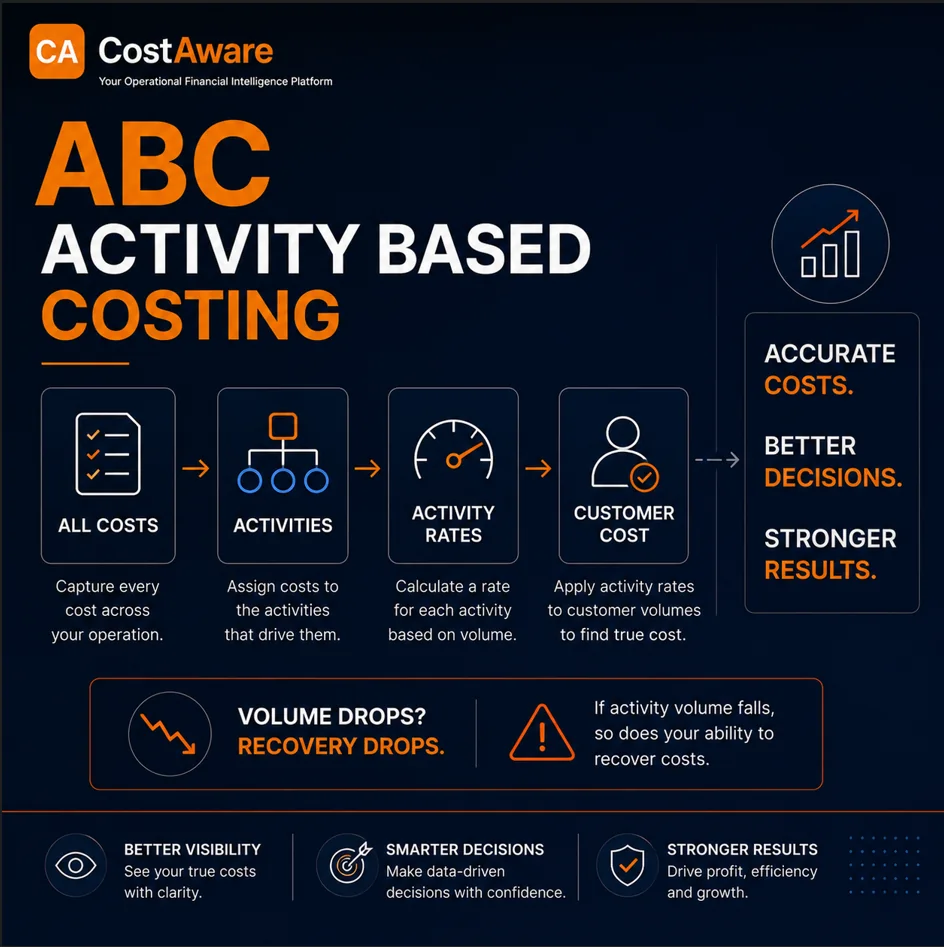
What ABC Means in a Warehouse Context
Activity-based costing in a 3PL warehouse is not the same as ABC in a textbook. In a textbook, ABC assigns costs to products. In a warehouse, ABC assigns costs to billable activities: receiving a pallet, picking a carton, packing an order, loading a container.
The goal is to take every dollar the warehouse spends and trace it to one of these activities so you can calculate a defensible cost-per-unit rate for each line on your rate card.
The process works by sorting all costs into pools, then distributing each pool across the rate card lines based on how much of that cost each activity consumes.
The Five Cost Pools
Every warehouse cost falls into one of five allocation pools. The pool determines how that cost gets distributed to rate card lines.
| Pool | What Goes In | How It's Allocated |
|---|---|---|
| Activity | Warehouse wages, MHE lease/maintenance, training | By FTE percentage per task |
| Fixed Overhead | Rent, outgoings, insurance, security, cleaning, services | Evenly across all rate card lines |
| Salary Overhead | Site manager, supervisor, admin staff salaries | Evenly across all rate card lines |
| IT | WMS licences, scanners, IT equipment run costs | Evenly across all rate card lines |
| Consumables | Wrap, labels, packaging materials | Direct to consuming activity |
The distinction between "Activity" and everything else is critical. Activity costs are allocated proportionally based on how much labour each task requires. All other pools are spread evenly, because those costs exist regardless of which specific activity is happening.
How Activity Allocation Works
The Activity pool is the largest and most complex. It typically contains 60-70% of total warehouse cost. The allocation uses FTE percentages: each activity task's share of total site FTE determines its share of the Activity cost pool.
Allocated Activity Cost = Total Activity Pool x Allocated FTE %
| Task | FTE | FTE % | Allocated Cost |
|---|---|---|---|
| Receiving Unload | 1.21 | 16.4% | $80,161 |
| Putaway | 0.74 | 10.0% | $48,878 |
| Carton Pick | 3.36 | 45.5% | $222,451 |
| Packing | 0.92 | 12.5% | $61,130 |
| Despatch Load | 0.68 | 9.2% | $44,983 |
| Other tasks | 0.46 | 6.4% | $31,201 |
| Total | 7.37 | 100% | $488,804 |
Carton picking consumes 45.5% of the activity cost pool because it uses 3.36 of the 7.37 total FTEs.
This is why accurate FTE calculations matter so much. If your FTE numbers are wrong, every activity allocation downstream is wrong too.
How Overhead Allocation Works
The remaining four pools (Fixed Overhead, Salary Overhead, IT, and Consumables) are simpler. Fixed Overhead, Salary Overhead, and IT costs are spread evenly across all rate card lines. If you have 8 rate card lines, each line absorbs one-eighth of those pools.
Consumables are different. They're allocated directly to the activity that uses them. If packing uses stretch wrap, the stretch wrap cost goes entirely to the packing rate card line, not spread across all lines.
From Cost Pools to Rate Card Rates
Once every dollar has been allocated to a rate card line, you have the total annual cost for that activity. Divide by the annual volume and you get the cost-per-unit rate.
Rate Per Unit = Total Line Cost / Annual Volume
| Component | Annual Cost |
|---|---|
| Activity allocation (45.5% of pool) | $222,451 |
| Fixed overhead (1/8 share) | $93,208 |
| Salary overhead (1/8 share) | $23,460 |
| IT allocation (1/8 share) | $4,120 |
| Consumables (direct) | $0 |
| Total line cost | $343,239 |
| Annual volume | 245,000 cartons |
| Rate per carton | $1.40 |
That $1.40 per carton is a fully loaded rate. It covers wages, equipment, rent, insurance, management salaries, IT, and every other cost the warehouse incurs to pick that carton. When the customer sees $1.40 on the rate card, they can audit exactly how it was derived.
Margin and Corporate Overhead
The rates above cover costs. They don't include profit or corporate overhead. Most 3PL operators apply these as percentages on top of the total cost base.
A typical structure is 3% corporate overhead (head office costs, shared services) and 12% margin. These are applied to the base warehouse cost, which is the sum of all five cost pools before markup.
Corporate Overhead = Base Cost x Overhead %
Margin = Base Cost x Margin %
Total Warehouse Budget = Base + Overhead + Margin
Some operators apply these sequentially (overhead first, then margin on the overhead-inclusive number). Others apply both directly to the base. The approach should be consistent across all sites and contracts.
Why This Matters for Tender Responses
When you're responding to a 3PL tender, the customer will scrutinise your rate card. They'll compare your per-pallet receiving rate against competitors. They'll question why your pick rate is higher or lower than expected.
With ABC allocation, you can answer those questions. You can show exactly which costs feed into each rate, how those costs were calculated, and what assumptions drive them. If the customer challenges your pick rate, you can demonstrate that 45.5% of your activity cost pool goes to picking because it consumes 3.36 of your 7.37 FTEs.
Without ABC, you're defending a number that came from a spreadsheet cell with no visible audit trail. That's a conversation nobody wins.
Common Mistakes
Putting wages in the wrong pool. Warehouse floor wages (store persons, team leaders, leading hands) belong in the Activity pool. Site manager and admin salaries belong in Salary Overhead. Mixing them distorts the FTE-based allocation for activity costs.
Missing cost sources. Security guards, cleaning contracts, and other services are often forgotten in overhead pools. If they're not in a pool, they're not in the rate card, and you're underpricing.
Inconsistent pool definitions across sites. If Site A puts insurance in Fixed Overhead but Site B puts it in Activity, your multi-site rate comparisons are meaningless. Pool definitions must be standardised.
Not recalculating when inputs change. ABC allocation depends on FTE percentages, which depend on volumes, which change. When a customer updates their forecast, the entire allocation chain needs to recalculate. In a spreadsheet with 20 tabs, this is where formula errors creep in.
The Calculation Chain
ABC doesn't exist in isolation. It sits in the middle of a larger calculation chain that starts with volumes and ends with a customer-facing rate card.
1. Customer volumes (pallets, cartons, orders per annum)
2. FTE calculation (volumes / productivity rates / utilisation)
3. Labour costing (FTEs x loaded wage rates)
4. ABC allocation (distribute all costs into pools, then to rate card lines)
5. Rate calculation (allocated cost / volume = per-unit rate)
6. Margin application (overhead % + margin % on base cost)
7. Rate card (final per-unit rates for customer)
Every step feeds the next. Change the volume assumption in step 1, and steps 2 through 7 must all recalculate. This is why structured platforms exist: they enforce the dependency chain automatically, so you can change an input and trust that every downstream number updates correctly.
Automate Your Cost Allocation
CostAware handles the entire volume-to-rate-card chain, including ABC allocation, for Australian 3PL operators.
Learn More →