How to Calculate Warehouse FTE from Volume
The foundation of every warehouse cost model is a simple question: how many people do we need? This guide walks through the volume-driven methodology used by major Australian 3PL operators to calculate FTE staffing requirements.
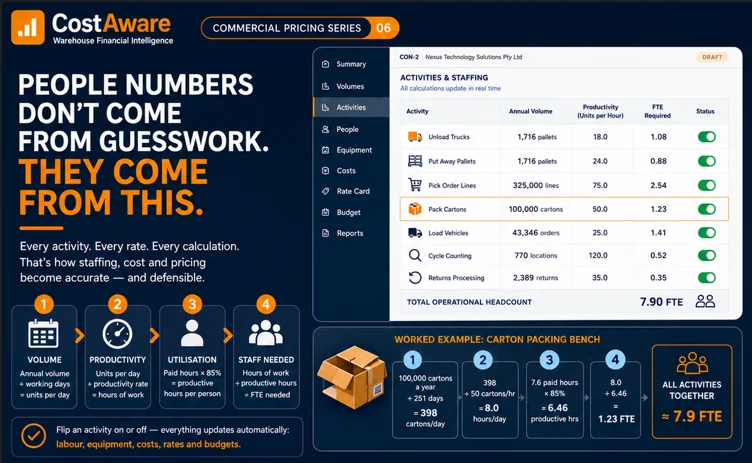
Why Volume-Driven Matters
Most warehouse staffing discussions start with headcount. Someone says "we need 8 people" based on experience, gut feel, or what the last warehouse had. This approach is fragile because it can't be audited, can't adapt when volumes change, and can't be consistently replicated across sites.
Volume-driven FTE calculation works in the opposite direction. You start with expected throughput (pallets, cartons, orders), apply productivity rates, factor in utilisation, and arrive at a defensible FTE number that directly ties back to the volumes you've committed to handle.
The Core Formula
FTE Required = Units Per Work Day / Productivity Rate Per Hour / (Productive Hours Per Day x Labour Utilisation %)
Working Days Formula Working Days Per Annum = Work Days Per Week x 52 - Public Holidays
Each variable in this formula has a specific meaning and source.
Breaking Down Each Variable
Annual Volume is the expected throughput for the activity over 12 months. For a receiving task, this might be 15,600 containers per annum. For a picking task, 245,000 cartons. The volume comes from the customer's forecast or the RFP specifications.
Working Days Per Annum adjusts for the operating schedule. A standard 5-day warehouse has 251 working days (5 x 52 = 260, minus 9 public holidays). A 6-day operation has 303. A 7-day operation has 355.
Productivity Rate Per Hour is how many units one person can process per hour for that specific task. This is the most sensitive variable in the model. A receiving unload task might have a rate of 20 pallets per person per hour. A carton pick might be 45 cartons per hour. These rates come from time studies, industry benchmarks, or historical WMS data.
Productive Hours Per Day is the actual working time per shift, excluding breaks. A standard 7.6-hour shift (common under Australian awards) typically yields 7.6 productive hours if breaks are unpaid, or less if breaks are included in shift length.
Labour Utilisation accounts for non-productive time that isn't captured by breaks: toolbox talks, OH&S briefings, equipment warm-up, travel time between zones, and general downtime. A typical utilisation rate is 85%, meaning 15% of productive hours are consumed by necessary but non-billable activities.
Worked Example
| Variable | Value | Source |
|---|---|---|
| Annual Volume | 245,000 cartons | Customer RFP |
| Work Days Per Week | 5 | Operating schedule |
| Working Days PA | 251 | 5 x 52 - 9 |
| Units Per Work Day | 976 | 245,000 / 251 |
| Productivity Rate | 45 cartons/hour | Time study |
| Productive Hours/Day | 7.6 | Award standard |
| Labour Utilisation | 85% | Site benchmark |
| FTE Required | 3.36 | 976 / 45 / (7.6 x 0.85) |
This tells you the picking operation needs 3.36 FTEs for that volume. In practice, you'd round to 3.5 or 4 depending on shift structure and whether partial FTEs are practical.
Rolling Up to Site-Level FTE
A warehouse typically has 10-15 distinct activity tasks: receiving unload, putaway, picking (multiple types), packing, despatch loading, returns processing, stock counting, and so on. Each task gets its own FTE calculation using task-specific productivity rates. The total site FTE is the sum of all task-level FTEs.
This is where spreadsheets start to struggle. With 13 tasks, each with their own volume source, productivity rate, and utilisation factor, the calculation chain has dozens of interdependent cells. Change the working days assumption and every task must recalculate. In a structured platform, this happens automatically.
Common Pitfalls
Using headcount instead of FTE. Headcount is the number of bodies; FTE factors in part-time, shift patterns, and leave cover. Always model in FTE and convert to headcount later.
Ignoring utilisation. Assuming 100% utilisation overstates productivity by 15-20%. The result: you underprice the contract and lose money for years.
Static productivity rates. A rate that works for a 5-day operation may not apply to a 7-day operation (fatigue, shift premiums, different workforce mix). Always validate rates against the specific operating model.
Forgetting seasonal variation. Annual averages smooth out peaks. If you're staffing to average volume but contractually obligated to handle peak volume, you'll need surge capacity the FTE number doesn't capture.
From FTE to Cost
Once you have total site FTE, the next step is costing. Each FTE carries a loaded cost that includes base wage (from the applicable EBA or award), superannuation, payroll tax, workers' compensation, annual leave provisions, long service leave, and any site-specific allowances. The formula for a fully loaded FTE cost is typically 25-35% above the base hourly rate, depending on the state and award.
This FTE cost feeds directly into the ABC (activity-based costing) allocation that distributes labour costs into rate card pricing. But that's a topic for another article.
Skip the Spreadsheet
CostAware automates the entire volume-to-FTE-to-cost calculation chain for Australian 3PL operators.
Learn More →